In a heated congressional session in May 2025, House Democrats unanimously rejected the Safeguard American Voter Eligibility (SAVE) Act, a bill mandating proof of citizenship for federal voter registration. The legislation, passed by Republicans with a narrow 221-198 vote, has reignited a fierce debate over election security, voter access, and the integrity of the democratic process. Critics argue that Democrats’ refusal to support voter ID requirements reveals a troubling stance on the value of lawful votes, while supporters of the opposition counter that such measures disproportionately harm marginalized communities.
The SAVE Act, championed by House Speaker Mike Johnson, requires individuals to provide documentation, such as a passport or birth certificate, to register for federal elections. It also directs states to remove non-citizens from voter rolls and imposes penalties for registering ineligible voters. Proponents, including former President Donald Trump, argue that the bill is essential to prevent non-citizens from voting, citing unverified claims of widespread fraud. A 2024 Heritage Foundation report estimated that 1-2% of votes in recent elections may have been cast by non-citizens, though evidence remains anecdotal and contested. Republicans assert that voter ID laws, supported by 85% of Americans according to a 2023 Gallup poll, are a commonsense safeguard to ensure only eligible citizens influence elections.
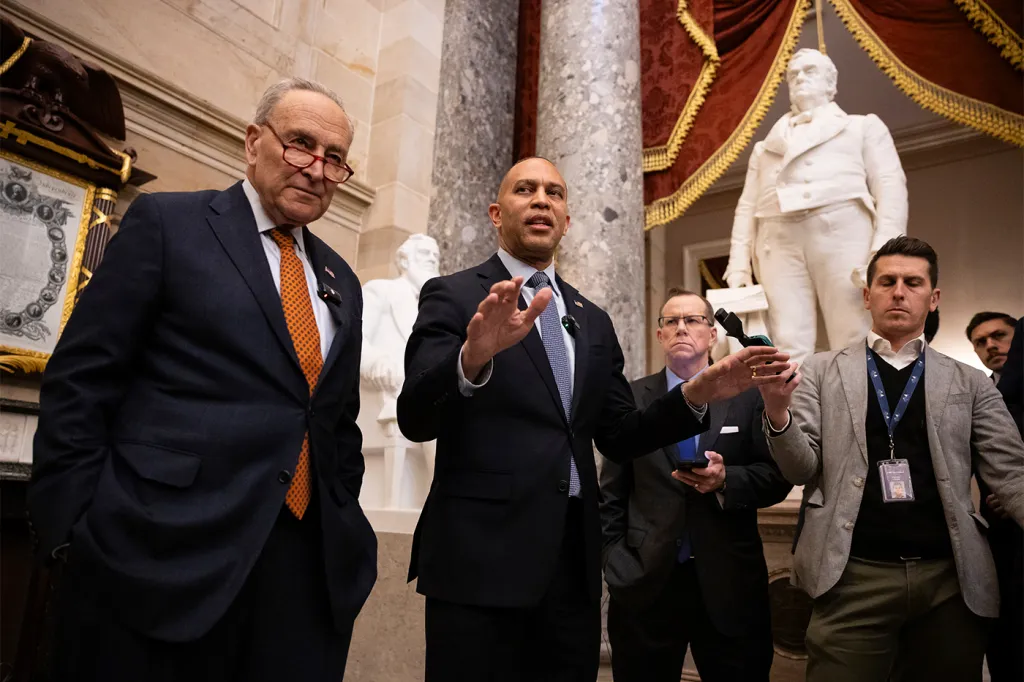
Democrats, led by Minority Leader Hakeem Jeffries, argue that the SAVE Act is a solution in search of a problem, designed to suppress turnout among low-income, minority, and elderly voters. They point to studies, like one from the Brennan Center in 2022, showing that voter fraud is exceedingly rare, with only 0.0003% of votes in a 2014 election found to be fraudulent. Critics of the bill highlight that 11% of eligible voters—disproportionately Black, Hispanic, and low-income individuals—lack easy access to required identification. Democrats contend that the act’s stringent requirements, coupled with state-level purges of voter rolls, could disenfranchise millions while doing little to address a statistically negligible issue.
The debate taps into deeper partisan divides. Republicans frame their push for voter ID as a defense of electoral integrity, arguing that even a small number of illegal votes undermines public trust. They point to cases like a 2023 Texas audit that identified 1,600 potentially ineligible voters, though most were later cleared. Democrats, however, see the bill as part of a broader Republican strategy to restrict voting access, citing historical parallels to Jim Crow-era laws that used administrative hurdles to suppress minority votes. The ACLU has warned that the SAVE Act could lead to erroneous removals from voter rolls, particularly in states with aggressive verification processes.
The bill’s passage in the House sets the stage for a contentious Senate battle, where Republicans hold a slim 53-47 majority. Senate Majority Leader John Thune has signaled strong support, but passage remains uncertain without bipartisan backing. Democrats, including Senator Raphael Warnock, have proposed amendments to fund free ID programs for low-income voters, but these were rejected by the House. The impasse underscores a fundamental disagreement: Republicans prioritize security, while Democrats emphasize accessibility.
As the 2026 midterms approach, the voter ID debate will likely shape campaign narratives. Republicans are already framing Democrats’ opposition as evidence of indifference to electoral fairness, while Democrats warn of a deliberate effort to erode democratic participation. Both sides claim to champion the sanctity of the vote, but their visions of how to protect it remain irreconcilable. The outcome of this legislative fight will not only influence election policy but also test public faith in the democratic process.