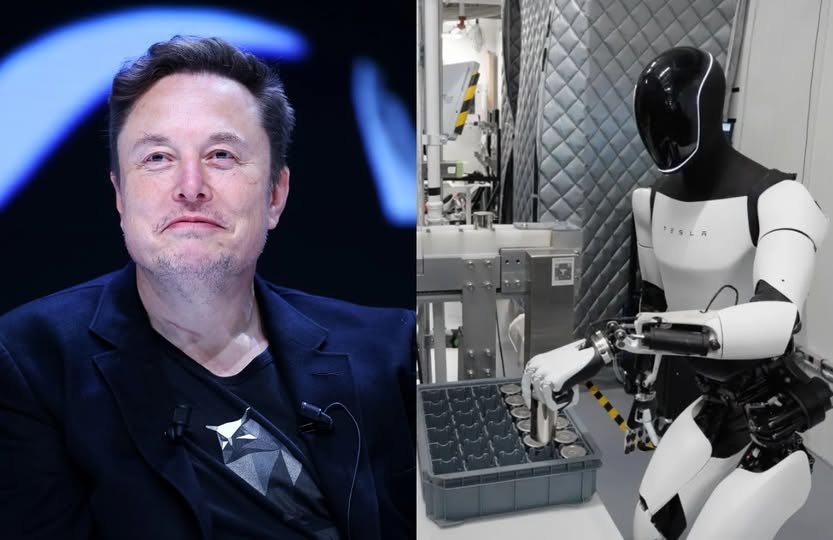
Palo Alto, CA – When Elon Musk unveiled Tesla’s Optimus humanoid robot in 2021, the world watched with bated breath. The promise was audacious: a machine capable of transforming labor by handling tasks from folding laundry to assembling cars. Yet, the initial reveal—a man awkwardly dancing in a spandex suit—drew laughter and skepticism, with critics dismissing it as a publicity stunt. Four years later, Tesla’s Optimus has evolved into walking, box-lifting prototypes powered by advanced AI. But as Musk hails it as a game-changer surpassing the Model T or the internet, detractors argue it’s still a distant dream far from practical use.
At Tesla’s 2024 “We, Robot” event, Optimus stole the spotlight. The latest prototypes, standing roughly 5’8” and weighing about 125 pounds, demonstrated basic mobility, object manipulation, and navigation using neural networks trained on Tesla’s autonomous driving tech. Musk showcased videos of Optimus sorting packages and serving drinks, claiming it could soon replace humans in repetitive or dangerous jobs. He predicted a $20,000 price tag and mass production by 2027, envisioning a future where humanoid robots outnumber humans. “Optimus will make life multiplanetary and solve labor shortages,” Musk declared, framing it as a cornerstone of his mission to advance human civilization.
The tech community, however, remains divided. Supporters point to Tesla’s progress: Optimus now uses end-to-end AI, allowing it to learn tasks through observation, much like a human. Its hands, with 22 degrees of freedom, mimic human dexterity, a feat engineers call groundbreaking. Tesla’s integration of its Dojo supercomputer for training Optimus’s AI further bolsters optimism. Posts on X reflect excitement, with users calling it “the dawn of a robotic age.” Some analysts estimate Optimus could generate trillions in revenue by 2035, revolutionizing industries like manufacturing and eldercare.
Skeptics, however, see more flash than substance. Robotics experts note that Optimus lags behind competitors like Boston Dynamics’ Atlas, which boasts superior agility. Critics argue that Tesla’s demos—carefully staged and lacking real-world complexity—overpromise what’s feasible. “It’s impressive, but we’re a decade from meaningful deployment,” said Dr. Angela Chen, a robotics professor at MIT, citing challenges in battery life, cost, and safety. Web reports highlight glitches in early demos, with Optimus struggling on uneven terrain. On X, detractors mock Musk’s timeline, with one user quipping, “Optimus will be serving coffee when we’re all on Mars.”
Musk’s track record fuels the debate. His knack for turning bold visions—like SpaceX’s reusable rockets—into reality lends credibility. Yet, Tesla’s history of missed deadlines, from the Cybertruck to Full Self-Driving, invites caution. Regulatory hurdles also loom: humanoid robots in public spaces raise ethical and legal questions, from workplace displacement to privacy concerns. The International Federation of Robotics estimates only 10,000 humanoid robots exist globally, underscoring the gap between Musk’s ambition and current reality.
As Tesla ramps up Optimus production, the stakes are high. Musk claims the robot could make Tesla a $1 trillion company, dwarfing its automotive business. Investors seem to agree, with Tesla’s stock surging 15% after the 2024 event. But failure to deliver could dent Musk’s reputation as a tech prophet. For now, Optimus is a tantalizing glimpse of the future—walking, working, and sparking debate. Whether it becomes the Model T of robotics or another overhyped promise remains to be seen.
The world awaits Musk’s next move. Will Optimus reshape society, or is it just a man in a suit, upgraded with circuits? Only time will tell.