Doha, Qatar – On May 14, 2025, President Donald Trump secured a staggering $1.2 trillion economic commitment from Qatar, a landmark achievement announced by the White House during his Middle East tour. This follows a $600 billion investment pledge from Saudi Arabia just a day earlier, signaling a significant boost to American manufacturing and innovation. The deals, celebrated as a pathway to a “new Golden Age,” reflect the economic focus that Trump’s supporters demanded when they voted him into office in November 2024, though questions linger about the long-term implications of such agreements.
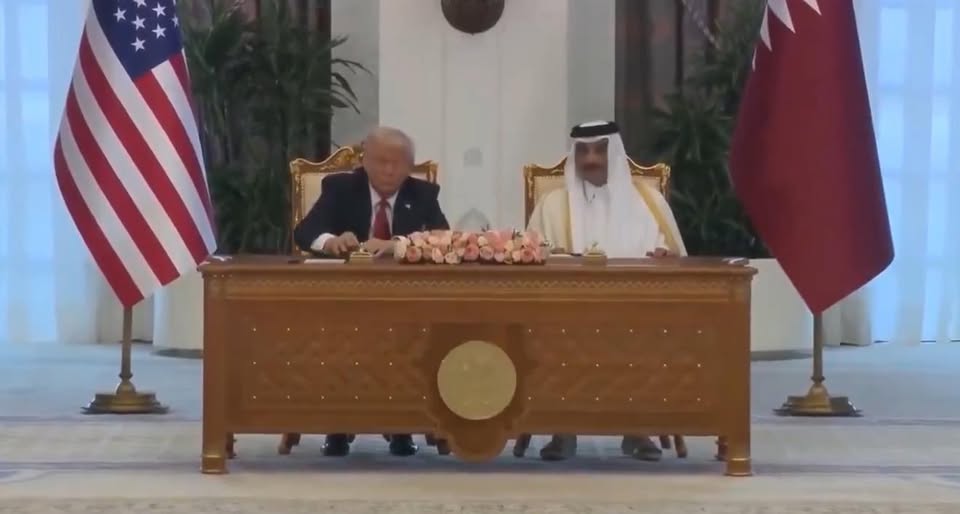
The Qatar commitment, signed alongside Emir Sheikh Tamim bin Hamad Al-Thani, encompasses a range of economic exchanges, including a $96 billion deal for Qatar Airways to purchase 210 Boeing 787 Dreamliner and 777X aircraft, powered by GE Aerospace engines. Additional agreements involve defense and technology, with Raytheon securing a $1 billion contract for counter-drone systems and General Atomics finalizing a $2 billion deal for MQ-9B drones, as detailed in a White House fact sheet. A statement of intent also outlines potential $38 billion investments in Al Udeid Air Base, a key U.S. military hub, alongside air defense and maritime security enhancements. The White House hailed these deals as a driver of “innovation and prosperity for generations,” emphasizing their role in strengthening American technological leadership.
This follows Trump’s Saudi Arabia visit on May 13, where he secured a $600 billion investment commitment, including $20 billion from Saudi DataVolt for AI data centers in the U.S., alongside a $142 billion arms deal. Together, these agreements total $1.8 trillion in foreign investment within two days, a figure Trump has leveraged to tout his dealmaking prowess. “We’re bringing back ‘Made in America’ like never before,” Trump declared at a Doha signing ceremony, echoing his campaign promise to revitalize U.S. manufacturing. Supporters on X celebrated the news, with many citing it as proof of Trump’s economic strategy resonating with the mandate voters gave him in 2024.
The Boeing deal, in particular, is a lifeline for the American aerospace giant, which has struggled with safety scandals and a 2024 order slump. The White House estimates it will support one million U.S. jobs, a significant win for an industry battered by global competition. Qatar’s investment also includes a $1 billion joint venture with Quantinuum for quantum technology development, aligning with Trump’s push for technological dominance. However, the figures don’t fully add up—individual deals in Qatar total $243.5 billion, leaving the $1.2 trillion claim under scrutiny, as noted by Sky News correspondent Paul Kelso on May 14.
Critics, however, raise concerns about the ethical and strategic costs. Qatar’s gift of a $400 million Boeing 747-8 to serve as a temporary Air Force One, announced during the visit, has sparked controversy. Ethics experts argue it violates the Constitution’s Foreign Emoluments Clause, with Democrats like Rep. Ritchie Torres calling it “farcically corrupt.” Qatar’s role as a mediator in U.S.-Hamas talks during the Gaza War adds another layer of complexity, with some, including Rep. Ted Cruz, warning of security risks tied to the plane deal. The broader geopolitical implications—particularly what Qatar and Saudi Arabia expect in return—remain opaque, fueling speculation about potential concessions on U.S. foreign policy or technology transfers.
While these deals promise economic growth, they also highlight Trump’s transactional approach to diplomacy, prioritizing business over traditional geopolitical concerns like Saudi Arabia’s human rights record or Qatar’s regional influence. The $1.8 trillion in commitments may indeed usher in a manufacturing renaissance, as Trump claims, but the lack of transparency and potential ethical breaches risk undermining long-term U.S. credibility. For now, Trump’s base celebrates a victory, but the true cost of these “landmark deals” may only emerge in the years ahead.