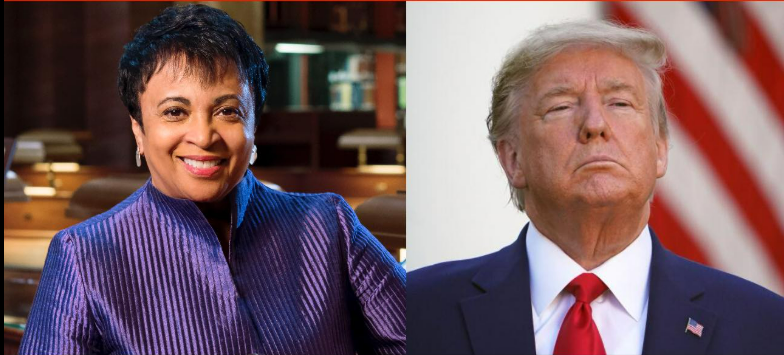
Washington, D.C., May 9, 2025 — President Donald Trump has fired Carla Hayden, the Librarian of Congress, in a move that has ignited fierce debate over the politicization of one of America’s most revered cultural institutions. Hayden, the first woman and first African American to hold the position, received a curt email from the White House on May 8, terminating her role effective immediately—over a year before her 10-year term was set to expire in September 2026.
The dismissal follows weeks of pressure from the conservative American Accountability Foundation (AAF), which accused Hayden of pushing “radical” children’s books and works by Trump critics, labeling her “woke, anti-Trump, and promoting trans-ing kids” in a May 8 X post just hours before her firing. AAF’s campaign is part of a broader effort to target officials seen as obstructing Trump’s agenda, with the group’s president, Tom Jones, urging Trump to “show Hayden the door” as early as May 1. AAF celebrated the firing as a win, posting, “THANK YOU
@POTUS !!!! Woke & radical Librarian of Congress Carla Hayden has been fired.”
Hayden, appointed by President Barack Obama in 2016, modernized the Library of Congress, digitizing collections and making artifacts like James Madison’s flute—famously played by Lizzo in 2022—more accessible. But conservatives criticized her for allegedly promoting books on gender identity, a charge Hayden defended as part of librarians’ duty to provide diverse knowledge. Earlier this week, she faced scrutiny over a library project’s rising costs, though this was not cited as a reason for her dismissal.
Democrats decried the firing as a blatant political purge. House Minority Leader Hakeem Jeffries called it “unjust,” vowing “accountability for this unprecedented assault on the American way of life.” Rep. Rosa DeLauro, the top Democrat on the House Appropriations Committee, labeled it “callous,” arguing it “undermines the foundational principles of our democracy.” Rep. Joe Morelle (D-NY) plans to introduce legislation ensuring the Librarian of Congress is appointed by Congress, not the president, calling Trump’s action a “complete disgrace.” Senators Martin Heinrich (D-NM) and Alex Padilla (D-CA) praised Hayden’s “barrier-breaking career,” decrying the move as an attack on democratic institutions.
Trump’s supporters, however, see the firing as a necessary step to combat progressive influence. Since taking office in January 2025, Trump has fired thousands of federal employees, aligning with the Project 2025 agenda to reshape the government in his image. Hayden’s dismissal fits this pattern, reflecting a broader culture war over issues like gender identity in literature. AAF’s accusations echo conservative talking points about “woke” cultural leaders, though evidence of widespread indoctrination through the Library remains scant.
The firing raises serious questions about the independence of the Library of Congress, the nation’s largest library and a key resource for lawmakers. Critics argue that Trump’s decision prioritizes loyalty over merit, eroding public trust in institutions. “It’s not about justice. It’s about submission,” read a viral X post from
@teflonthadon, accusing Trump of “silencing expertise to fuel ignorance.” The lack of transparency—Trump has not publicly explained the firing—further fuels concerns about authoritarianism.
Hayden’s tenure was marked by efforts to democratize access to knowledge, but her ouster highlights the growing politicization of nonpartisan roles. The Library of Congress, meant to serve as a bastion of intellectual freedom, risks becoming a battleground in America’s culture wars. Democrats are pushing back, but with Trump’s base cheering the move, the divide deepens. As one X user put it, “This isn’t about books—it’s about control.”
The firing underscores a troubling trend in Trump’s second term: the targeting of perceived opponents to appease his supporters. While conservatives may see it as a victory, the long-term cost to institutional integrity could be steep. For now, Hayden’s abrupt exit leaves the Library of Congress—and the nation—grappling with the fallout of a decision that speaks more to politics than principles.