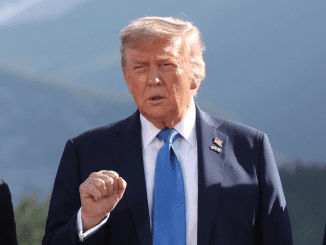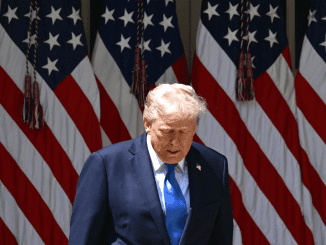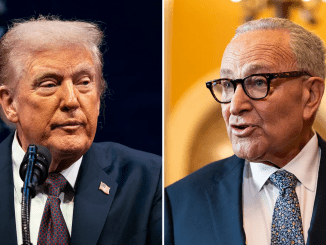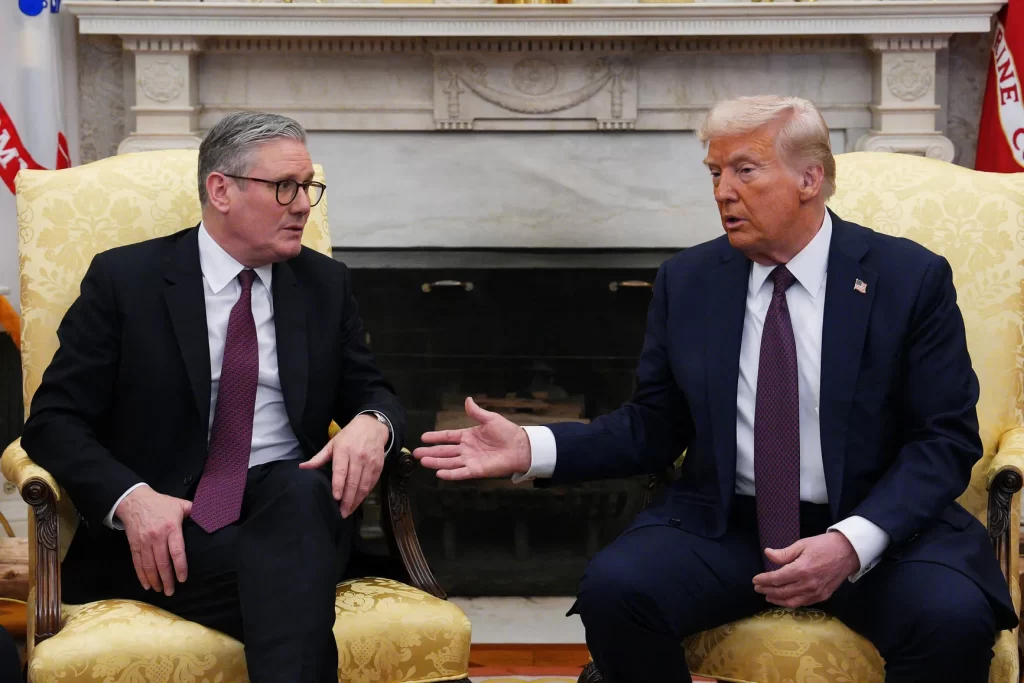
Washington, D.C., May 8, 2025 — President Donald Trump took to the Oval Office this morning to announce what he called a “full and comprehensive” trade deal with the United Kingdom, touting it as a major win for his administration. But behind the fanfare, experts and critics are calling the announcement little more than a hollow gesture—a framework for future negotiations rather than a concrete agreement. The revelation has sparked skepticism, with many questioning the significance of the deal given the U.S.’s existing trade surplus with the UK.
Trump’s announcement came at 10:00 a.m. ET, following a cryptic Truth Social post the previous night teasing a “major trade deal” with a “highly respected” country. Flanked by British trade officials, Trump declared the agreement the “first of many” in his ongoing trade war, which began with sweeping tariffs in April 2025. Those tariffs—a 10% baseline on most nations, with higher rates on steel, aluminum, and autos—had strained relations with allies like the UK, prompting Prime Minister Keir Starmer to seek a deal to ease the burden on British exports.
The framework offers some concessions: increased U.S. market access for beef and ethanol, reduced non-tariff barriers for American goods in the UK, and a commitment from the UK to lower its digital services tax, a 2% levy on U.S. tech giants that had long irked Washington. In return, the U.S. agreed to reduce tariffs on UK steel, aluminum, and cars, which had faced 25% levies. But the agreement stops short of a full trade deal, setting a roadmap for future talks on thornier issues like agriculture and pharmaceuticals.
Critics were quick to pounce. “Trump’s not announcing a trade deal this morning, he’s announcing a framework to continue negotiations with the UK, a country we currently have a trade surplus with,” read a viral post from
@OccupyDemocrats. “Much ado about nothing!” The U.S. indeed enjoys a trade surplus with the UK—$11.9 billion in 2024, up 17.4% from the previous year—undermining the urgency of the deal. Timothy Brightbill, an international trade attorney, told The New York Times that the announcement likely amounts to “an agreement to start negotiations, identifying a framework of issues to be discussed in the coming months.”
The UK’s perspective is more nuanced. For Starmer, the framework is a diplomatic win—the first deal secured since Trump’s tariffs disrupted global markets. It also bolsters the UK’s post-Brexit trade strategy, coming just days after a trade pact with India on May 6. However, British officials privately admitted to the Financial Times that the agreement falls short of the ambitious free trade deal once envisioned by the UK’s Conservative government. The UK has held firm on red lines, refusing to lower food standards to allow U.S. imports like hormone-fed beef or chlorinated chicken, which remain banned under EU-aligned regulations.
Market reactions were tepid. A post on X by HedgeVision noted that the $SPY and $QQQ indices sank after the announcement, suggesting the news was already “priced in.” Analysts like Allan Monks from JPMorgan predict minimal short-term economic impact for either nation, with the 10% baseline tariff on the UK still in place. The framework’s success hinges on future negotiations, which could take years—a timeline that clashes with Trump’s penchant for quick wins.
The announcement’s timing also raises questions. With U.S.-China trade talks looming in Switzerland on May 10, some speculate Trump is using the UK deal to project momentum. But his history of abandoning trade agreements, like the USMCA earlier in his second term, casts doubt on the framework’s longevity. For now, the deal appears more symbolic than substantive—a political talking point for Trump and a diplomatic lifeline for Starmer.
As the dust settles, the U.S.-UK trade framework leaves more questions than answers. While it signals a willingness to negotiate rather than escalate tariffs, its limited scope and the U.S.’s existing trade surplus with the UK fuel the perception that this is, indeed, much ado about nothing. For both nations, the real test lies ahead in turning this framework into a deal that delivers.