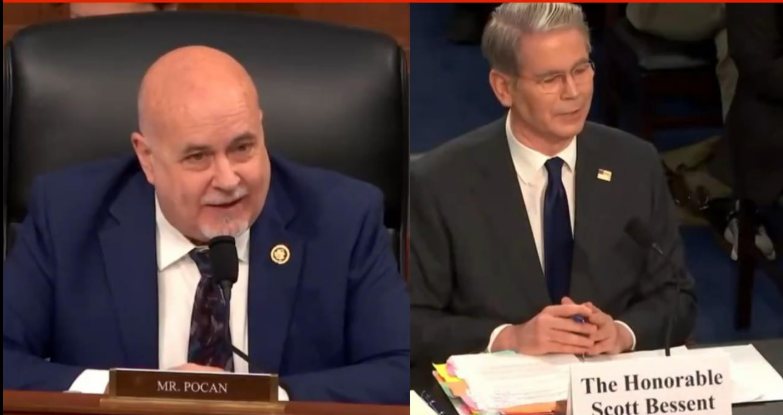
A fiery exchange at a House Oversight Committee hearing on May 6, 2025, has thrust President Donald Trump’s tariff policies into the spotlight, with Rep. Mark Pocan (D-WI) accusing Treasury Secretary Scott Bessent of dodging a simple yet damning question: “Who pays tariffs?” A viral image capturing the moment claims Bessent couldn’t answer because the truth—that American consumers, not foreign countries, bear the cost—unravels what Pocan calls a “MAGA lie.” The confrontation has reignited debate over the economic impact of Trump’s trade agenda.
During the hearing, Pocan pressed Bessent repeatedly on who pays tariffs, but Bessent faltered, calling it a “very complicated question,” per CNN. A clip shared by journalist Aaron Rupar on X shows Bessent stammering, “Well, Congressman, if the exporters… uh, dislike tariffs so much, why wouldn’t they…” before Pocan cut him off, saying, “You clearly aren’t going to answer.” Pocan later told MSNBC’s Lawrence O’Donnell on May 7, 2025, that it was “such a simple question,” accusing the administration of hoping Americans “never figure it out.” The viral image echoes this sentiment, stating, “We pay! Not China, not Mexico. WE DO,” and calling shame on the administration for its lack of transparency.
Trump’s tariff policy, a cornerstone of his economic agenda, includes a 10% baseline tariff on most imports and a 145% rate on Chinese goods, imposed on April 2, 2025, per Reuters. Bessent, defending the policy in an April 7, 2025, interview with Tucker Carlson, argued that tariffs fund the government, protect American workers, and provide leverage in trade negotiations, citing historical precedent from Alexander Hamilton. He also claimed tariffs could lead to tax cuts for the middle class and noted ongoing talks with 17 of America’s 18 largest trading partners (excluding China), per The Washington Times on May 6, 2025. Trump, speaking to NBC News on May 4, 2025, insisted that China “wants to make a deal very badly” due to the pressure from tariffs.
However, economists and critics like Pocan counter that tariffs act as a tax on Americans. The Latin Times explains that U.S. importers pay tariffs to Customs and Border Protection, often passing costs to consumers through higher prices. Pocan, in a May 1, 2025, X post, highlighted the impact on everyday goods like coffee, stating, “Trump’s blanket tariffs are a tax on the American people.” The Telegraph reported on May 7, 2025, that Ford faces a $1.5 billion hit from tariffs, with total costs of $2.5 billion, underscoring the broader economic toll. On X, users like
@Suzierizzo1 expressed frustration, writing, “Seriously WTF just be honest for once! We know it’s the taxpayers!”
The economic stakes are high. Pocan, speaking to PBS Wisconsin on May 2, 2025, cited a local medical device company struggling to sell to China due to retaliatory tariffs, despite sourcing 70% of its materials domestically. Bessent admitted to The Telegraph on May 7, 2025, that the national debt stands at $36.2 trillion, raising questions about whether tariffs can sustainably fund the government without further burdening Americans. Critics argue that the administration’s narrative—that foreign countries pay tariffs—misleads the public, a point Pocan drove home during the hearing.
Public reaction is polarized. On X,
@Phoenix_Ranger2 emphasized that “AMERICAN TAXPAYERS” pay tariffs, while
@OopsGuess called the administration’s strategy one of “lying to your own people.” Bessent claimed to have met with over 50 small lenders to address concerns, per Reuters, but his evasiveness during the hearing has fueled accusations of dishonesty. Pocan’s broader critique, as noted on WisPolitics, was meant to highlight the negative impact on Wisconsin businesses, but Bessent’s refusal to engage directly shifted the focus to transparency.
As of May 8, 2025, this confrontation underscores a fundamental divide over Trump’s economic policies. While tariffs may pressure foreign governments to negotiate, the immediate cost to American consumers is undeniable. Pocan’s viral accusation of a “MAGA lie” highlights the administration’s struggle to reconcile its trade rhetoric with economic reality, leaving many Americans questioning who truly pays the price.